
Reining in Pakistan's expanding nuclear weapons programme should be an international priority, according to an editorial in the New York Times which said that the country being home to many extremist groups adds to the dangers it presents for South Asia and the entire world.
The greenback's strength against other Asian currencies and lacklustre local equity markets made the rupee depreciate.

Here are the few candidates who are in contention for the readers' choice for Time magazine's 'Person of the Year' in 2016.

Speculation is rife that Xi is likely to make an attempt to initiate peace talks between Russia and Ukraine to end the ongoing conflict in Ukraine.
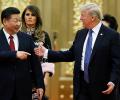
'We have here the world's largest economy and dominant superpower thrashing about as it wrestles with its own decline.' 'It has become everything that China was supposed to be: A threat to the world order, and as a country that is not playing by the rules on trade, on climate change, international commitments and nuclear deals,' says T N Ninan.

'China's growing nexus with Pakistan and the two countries' unresolved territorial disputes with India continue to pose a formidable national security threat to India,' says Brigadier Gurmeet Kanwal (retd).

Oppenheimer is a very politically significant film for our time, observes Utkarsh Mishra.

The reduction of tension on the Chinese border may have reduced the urgency of a Biden-Modi meeting, but the sooner Modi starts a bromance with Biden the better as he had done with Obama and Trump, suggests Ambassador T P Sreenivasan.
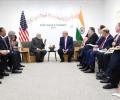
'The change of vocabulary in the India-US conversation was significant and refreshing.' 'It matched the styles of Trump and Modi.' 'The differences were not papered over, but there was determination to resolve them in the days ahead,' says Ambassador T P Sreenivasan.

India is the second largest buyer of Iranian crude, after China.

Ahead of his crucial talks with Russian President Vladimir Putin in Moscow, Chinese President Xi Jinping said on Monday that his peace plan to end the raging Ukraine war takes into account the 'legitimate' concerns of all parties and reflects the broadest common understanding of the international community.

The US president said he would meet without any precondition.

India needs to have a re-look of whole gamut of its relations with major powers and also prepare for a more turbulent neighbourhood. But such is the tyranny of Indian status quo mindset that any talk of re-look at nuclear doctrine or foreign relations is treated as blasphemy, says Colonel (retd) Anil Athale.

'Under Doval, foreign powers traditionally suspicious of India were wooed.' 'Enemies were embraced.'

Palestinians, who protested massively along the Gaza border clashed with Israeli forces.

While there were no surprises on policy issues from either side, there were far less interruptions and tense moments between Pence, 61, who comes from Indiana and his Democrat challenger Harris, 55, who is from California.


Aziz Haniffa/Rediff.com listens to four Indian and American national security advisers recalling the hard work that went into negotiating the nuclear deal.

'Despite almost $30 billion of funding since 2001, all the US reaps today is unmitigated hostility of a Pakistan emboldened to flaunt its China card.' 'How can the US give credence to any offers from Pakistan, which has trotted out the standard alibi of non-State actors time and again, including dreaded terror outfits being out of State control, Pakistan itself being a victim and so forth?'

'Alas, the Congress party offers no suggestions as to how to unscramble the omlette it cooked during 2004-2014 on which the Modi government may have since lavishly spread some tomato ketchup,' says Ambassador M K Bhadrakumar.

With Obama joining her on the stage for the first time, Clinton described what a presidency is all about.
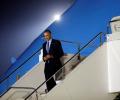
'Obama's visit to Hiroshima must generate a fresh debate in the international community about how to reduce the salience of nuclear weapons in international politics and how to disarm the world from these monstrous weapons forever,' says Sanjeev Shrivastav..

The agency had received Rs 946.51 crore to manage its affairs in the Budget Estimates for 2023-24, which was later increased to Rs 968.86 crore in the Revised Estimates.

Photographs from moments that shaped the world last week.

Government's fuel subsidy estimate was based on crude oil at $70.
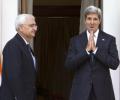
The United States on Monday assured India that its concerns over Taliban insurgents gaining legitimacy without severing their terror links will neither be "overlooked or undermined" during the talks with the Islamic fundamentalist group.

The WPI inflation stood at negative 2.4% in May 2015, compared with a negative 2.65% in April 2015.

'Had a very fruitful meeting with Iranian defence minister Brigadier General Amir Hatami in Tehran. We discussed regional security issues including Afghanistan and the issues of bilateral cooperation,' Singh said in a tweet.

Would Ukraine be such a pushover if it had that nuclear stockpile?' asks Shekhar Gupta.

Pompeo defended the killing of Soleimani saying he was making efforts for an attack on Americans in the region.

The Biden administration should expect continuity in Iran's policies under Raisi. This may not necessarily mean that strengthening of ties with the West will be Raisi's top priority, observes Ambassador M K Bhadrakumar.

The wife of a senior Israeli politician sparked a row after she posted a racially charged joke about US President Barack Obama on Twitter wherein she referred to him as "black and weak".
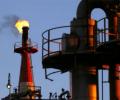
Oil has slumped from above $115 in June 2014 as shale oil from the United States has flooded the market

'Diplomatic engagement will continue even as India keeps all its options open with respect to discretely targeting the Pakistani military and its terrorist proxies.'

"It would be my hope that people understand why this particular transaction is important for us," the EAM said in Washington, DC.

Financials ended mixed despite the status-quo on key rates by the RBI. SBI, ICICI Bank and Axis Bank ended up 0.4-2.5% each.

The RBI has made serious attempts to improve fiscal deficit.

Haley warned Americans that a Biden-Harris administration would lead the country on the path of socialism, which has failed everywhere in the world.

The Democrats, especially the Biden administration, wanted to deliver a sharper message to Mr Modi than would be possible in a formal summit setting. So, why not get the most prominent Democrat in decades to deliver it?, explains Shekhar Gupta.

Politicians, bureaucrats hold different opinions about the delaying of the 2+2 summit.
